Eliza "Eli" Hartwell · Staff Writer · Field Report
Girth in Service of Purpose: The Thiccc Thing That Works
This week's entries share a quality the editorial board has not previously named: their girth is not incidental to their function, it is the mechanism by which the function is achieved.
Two Kinds of Large
There is a category of thiccc thing whose dimensions are, in some sense, optional. A wide staircase is more impressive than a narrow one, but the narrow one still conveys a person from one floor to another. The width is an expression of ambition, or budget, or civic pride. Remove it and the staircase persists. This is decorative girth, and it is not without merit.
Then there is a second category, rarer and more demanding: the thiccc thing whose girth is the mechanism. Remove the mass and the function does not diminish, it collapses entirely. This week's entries belong almost exclusively to that second category, and the distinction is worth the editorial board's time.
The Tuba as Structural Argument
Consider the Contrabass Tuba. Its bore diameter, the interior channel through which air travels, runs to approximately 26.5 millimetres at the valve block, expanding to a bell opening that can reach 500 millimetres across. These are not aesthetic choices. The contrabass tuba produces pitches in the range of B♭1, roughly 58 hertz, and the physics of low-frequency sound production require a resonating column of air whose volume is proportional to the wavelength being generated. A smaller instrument cannot produce that frequency at usable volume. The bell is wide because the note demands it.
The instrument weighs between 9 and 14 kilograms depending on configuration. A musician holds this against the body and plays it standing. The girth is not ceremonial. It is the condition of the sound existing at all.
The Transformer Does Not Apologise for Its Dimensions
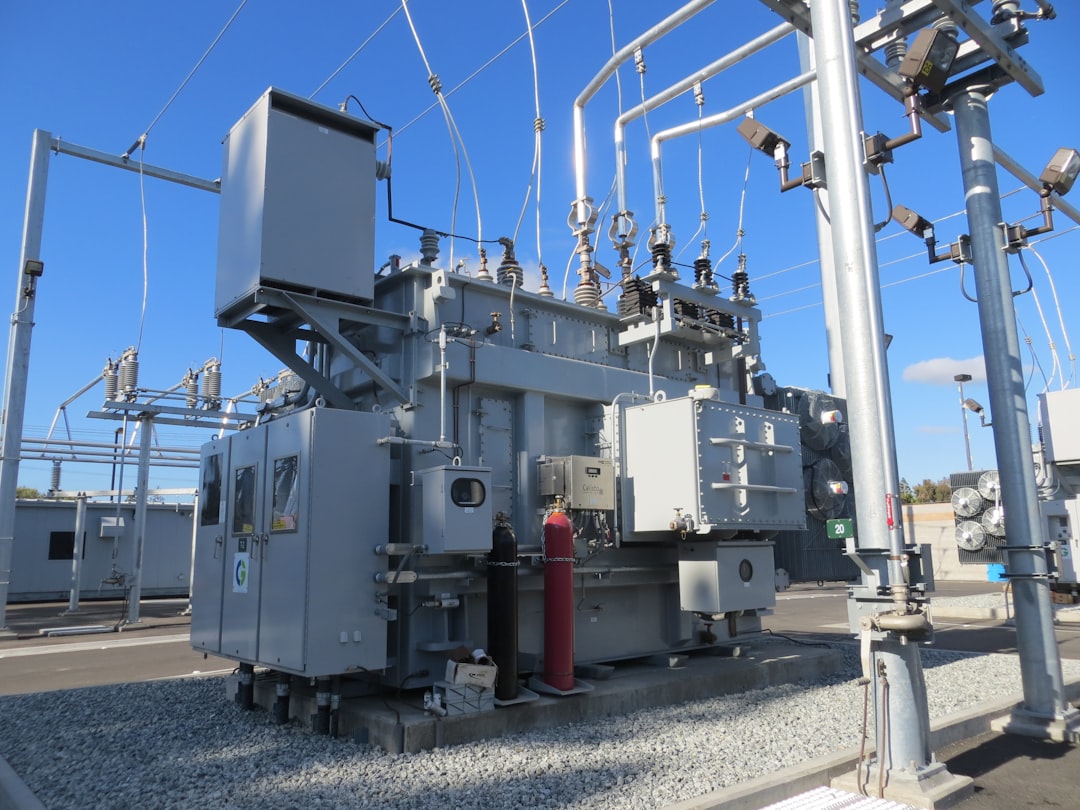
The Power Generation Transformer presents the same argument at a different scale. A large power generation transformer, the kind that steps voltage down from transmission-level currents of 400 kilovolts to distribution-level values, can weigh in excess of 300 tonnes and stand over 10 metres in height. The core laminations alone, stacked in their characteristic cruciform cross-section, may measure 1.5 metres across. The oil-filled tank surrounding them is not housing. It is a cooling system, an insulator, and a structural member simultaneously.
The relationship between voltage, current, and the cross-sectional area of the magnetic core is governed by Faraday's law of induction. To handle more power, the core must be larger. There is no workaround. The transformer is precisely as large as the electricity requires it to be. This is a form of dimensional honesty that the editorial board finds admirable.
What the Articulated Dumper Settles About Load
The Articulated Dumper Truck makes the same case in the language of civil engineering. A machine of this class, say, the Volvo A60H, carries 55 tonnes of payload on a frame that itself weighs 35 tonnes. The rear body, when loaded, sits atop a bogie axle arrangement designed to distribute that mass across ground that is, by definition, not prepared to receive it. The tyres alone stand approximately 1.8 metres tall. Their width, around 700 millimetres per tyre, is calculated from the ground pressure the subsoil can sustain before the machine sinks into its own worksite.
Each dimension answers a specific load condition. Reduce the tyre width and the machine founders. Reduce the frame mass and the structure fails under payload. The Volvo A60H is not large because largeness was desired. It is large because 55 tonnes of material required it to be, and the engineers stopped there.
Functional girth, girth that is the mechanism rather than the ornament, represents the highest order of thicccness the catalogue recognises. It is not always the most visually striking variety. A wide ceremonial staircase is often more arresting than a power transformer. But the functional thiccc thing has arrived at its dimensions through a process of elimination, not accumulation. The contrabass tuba has been reduced to the smallest form that can still produce B♭1 at concert volume. That form is enormous. The transformer has been reduced to the smallest core that can handle 400 kilovolts. That core is 1.5 metres across. The dumper has been reduced to the minimum frame capable of carrying 55 tonnes across soft ground. That minimum weighs 35 tonnes. In each case, the calculation was finished and the pencil was set down.
The editorial board recommends locating a contrabass tuba, inserting one's head into the bell, and reconsidering the concept of minimum viable volume.
A new entry every morning. Get it delivered.
From the Editorial Staff
Bartholomew "Bart" Pruss · Senior Cataloguer
Structurally sound. "Decorative girth" vs "functional girth" is a distinction the catalogue, properly understood, has needed since volume one. I remain skeptical of the specific entries, pending review.
Margaret "Margie" Whitmore-Hessian · Editor-in-Chief
Bertram made this exact point to Philippe Marchand at the '94 Geneva salon, standing next to a Bugatti EB110. Nobody listened. Eli, darling, you've essentially reinvented him. I'm not upset.